
A healthy heart is not a metronome. Even at rest, the gap between one heartbeat and the next changes slightly from beat to beat. That variation is called heart rate variability, or HRV.
It can seem odd that an irregular rhythm is a good sign. But this flexibility shows that your nervous system is constantly adjusting your heart to what your body needs. HRV has become one of the most widely studied measures of how well that system is working, and it now appears on millions of smartwatches.
What HRV is
Your heart rate is usually given as an average, such as 70 beats per minute. That does not mean a beat every 0.86 seconds exactly. Measured beat by beat, the gaps lengthen and shorten all the time [1].
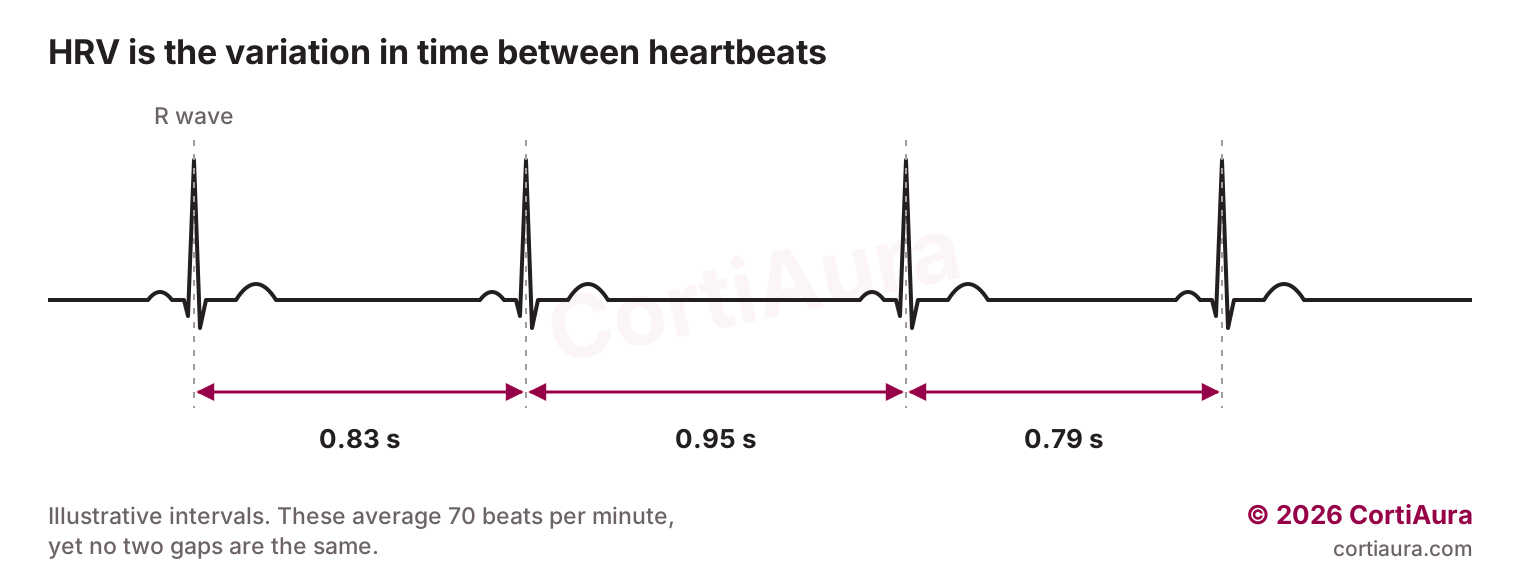
HRV is a measure of how much those gaps vary. Each gap is called an R-R interval, after the tall R wave that marks each beat on an ECG. Higher variability generally means your heart can adjust quickly. Lower variability means it is beating in a more fixed pattern [1].
The variation comes from your autonomic nervous system, the automatic system that runs your heart, gut, breathing and blood vessels. It has two branches. The sympathetic branch speeds the heart up for action. The parasympathetic branch, carried mainly by the vagus nerve, slows it down for rest and digestion. HRV reflects the constant push and pull between the two [2].
How HRV is measured
The most accurate way to measure HRV is an ECG, which records the electrical signal of each heartbeat. Chest-strap monitors also work from that electrical signal. Smartwatches and rings use light sensors on the skin to detect each pulse instead, which is more convenient but less precise [1, 11].
You will see HRV reported in a few different ways. These are the three most common:
- RMSSD: how much each beat differs from the one before. It mainly reflects vagus nerve (parasympathetic) activity, and most wearables use it.
- SDNN: the overall spread of beat intervals over the recording. It reflects total variability, from both branches of the nervous system.
- HF power: the variation that rises and falls with your breathing. It mainly reflects vagus nerve activity.
Most results are given in milliseconds. A short-term reading in clinical research usually lasts five minutes, taken while resting. Many wearables take readings overnight while you sleep, when fewer things disturb the measurement [1].
There is no single "normal" number. HRV varies widely between healthy people and falls naturally with age [1]. That is why your own trend over time matters far more than how you compare with someone else.
What HRV tells you about your body
HRV is not a diagnosis. It is a window into how flexibly your nervous system is working. Research links it to several areas of health.
Your nervous system's balance
Higher resting HRV usually reflects stronger vagus nerve activity, sometimes called vagal tone [3]. That is the "rest and digest" state, when your body repairs, digests and recovers. Lower HRV suggests the balance has shifted towards the "fight or flight" side, as happens with stress, illness or poor sleep.
Your heart
HRV was first taken seriously in cardiology. In a landmark 1987 study of heart attack survivors, people with low HRV were more likely to die in the following years [4]. Later work found the same pattern in people without known heart disease. A meta-analysis of eight studies and nearly 22,000 people found low HRV was linked to a 32–45% higher risk of a first heart attack, stroke or other cardiovascular event [5].
Diabetes
Diabetes can damage the nerves that control the heart, a condition called cardiovascular autonomic neuropathy. Its earliest sign is reduced HRV, often before any symptoms appear [6]. This is why HRV-based tests are used to check autonomic function in people with diabetes.
POTS
Postural tachycardia syndrome (PoTS, also written POTS) is a condition in which the heart rate rises excessively on standing up, without a fall in blood pressure [13, 14]. It causes dizziness, palpitations, fatigue and "brain fog", and often stomach and gut problems [13, 14]. It most often affects young women, and it can start after a viral infection [14]. The NHS notes it is more likely in people with long COVID, ME/CFS or joint hypermobility [13].
People with POTS tend to have lower HRV than healthy people. A meta-analysis of 20 studies, including more than 700 people with POTS, found lower RMSSD, a vagus nerve marker, during tilt-table testing [15]. This fits the picture of a nervous system that struggles to adapt the heart to changes in posture. HRV cannot diagnose POTS, which needs a standing or tilt-table test, but it helps explain why the symptoms happen.
Mental health
People with depression tend to have lower HRV than people without it. A large Dutch study of more than 2,300 adults confirmed this, but found that much of the difference was explained by antidepressant medication rather than the depression itself [7]. HRV and mood are linked, but the relationship is complex.
Stress and recovery
Short-term stress, a hard workout, a late night or a heavy meal can all lower HRV for a day or two. Once you recover, it usually returns to your normal range. Tracking this pattern can help show how well your body is recovering.
An important caveat: these are links found across large groups of people. A single low reading does not mean you have heart disease, diabetes or depression. HRV is one signal among many, and it is most useful alongside a proper clinical assessment.
What raises and lowers HRV
Many everyday factors move HRV up or down. Some you cannot change, such as age. Many you can.
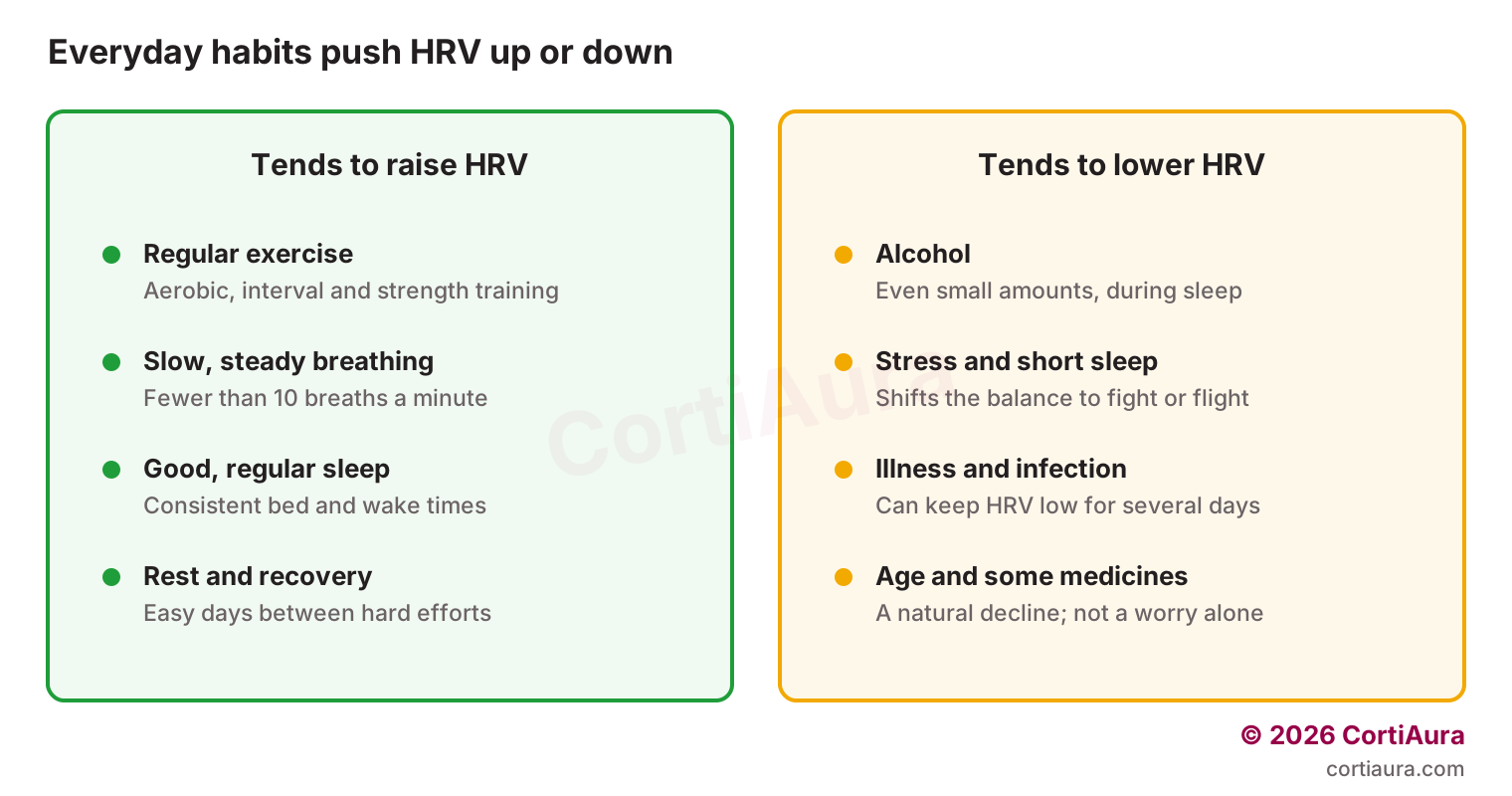
Exercise. Regular training is one of the most reliable ways to raise resting HRV. A 2024 network meta-analysis of randomised trials found that interval training, strength training and combined programmes all improved HRV measures in adults [8].
Breathing. In a review of 15 studies, slow breathing at fewer than 10 breaths a minute increased HRV and other signs of vagus nerve activity in healthy adults, although the authors describe the evidence as still limited [9]. HRV biofeedback, which trains slow breathing using a live heart rhythm display, produced large reductions in self-reported stress and anxiety across 24 studies [10].
Alcohol. In a study of more than 4,000 Finnish employees, alcohol lowered HRV and recovery during the first hours of sleep in a dose-dependent way. The effect showed up even after small amounts [12].
Sleep, stress and illness. Poor sleep, prolonged stress and infections all tend to lower HRV. If your HRV stays low for several days without an obvious reason, it can be a prompt to rest and look after yourself.
Age and medicines. HRV falls naturally as we get older [1]. Some medicines, including several antidepressants, also lower it [7]. Never stop or change a medicine because of an HRV reading; speak to your doctor first.
Reading your own HRV on a wearable
Smartwatches, rings and chest straps have made HRV easy to track at home. They can be genuinely useful, but accuracy varies a lot between devices. When researchers compared seven consumer products against a medical ECG, some came close to the ECG for RMSSD while others were far off [11].
A few rules make your numbers more meaningful:
- Compare yourself with yourself. Your personal baseline matters far more than anyone else's number or an online chart.
- Look at trends, not single days. A weekly average tells you more than one low reading.
- Measure the same way each time. Overnight readings, or a few minutes on waking before you get up, give the most consistent results.
- Note what changed. A late meal, a drink, a hard session or a bad night's sleep will usually explain a dip.
- Do not use it to diagnose. A wearable cannot tell you whether you have a heart condition. If you feel unwell, trust your symptoms over the number.
When to speak to a doctor
A low or falling HRV on its own is rarely a reason for concern. Speak to your GP if you also have:
- palpitations, a racing or irregular heartbeat
- dizziness or fainting, especially when standing up
- chest pain or breathlessness
- ongoing gut symptoms, sweating changes or other signs your automatic nervous system may not be working well
- diabetes, and new symptoms such as light-headedness on standing
If you have chest pain, severe breathlessness or collapse, call 999.
The bottom line
HRV is a simple number with a lot behind it. It reflects how flexibly your nervous system adapts your heart to everyday demands, and it is linked to heart, metabolic and mental health.
Used sensibly, as a personal trend rather than a verdict, HRV can show you how sleep, stress, alcohol and exercise affect your body.
To understand the nerve behind much of this variation, read what the vagus nerve does. For why we need better measurement of the gut-brain connection, read our article on measuring the gut-brain axis. To follow our work, join our Founding Community.
Frequently asked questions
What is a good HRV? There is no single good number. HRV varies widely between healthy people and falls with age. The most useful comparison is with your own baseline over weeks [1].
Is higher HRV always better? Generally, higher resting HRV reflects stronger vagus nerve activity and better adaptability. But some heart rhythm problems can make HRV look artificially high, so an unusually high reading is not automatically a good sign [1].
Can I improve my HRV? Often, yes. Regular exercise, slow breathing, good sleep and drinking less alcohol are all linked to higher HRV [8, 9, 12].
Are smartwatch HRV readings accurate? Accuracy varies between devices. Some agree closely with a medical ECG and others do not [11]. Wearables are best used to follow your own trends rather than to diagnose anything.
Declaration of interest: The author is the founder of CortiAura, a company developing vagus nerve technology. This article is educational and makes no claims about any product.
References
- Shaffer F, Ginsberg JP. An overview of heart rate variability metrics and norms. Frontiers in Public Health 2017;5:258.
- Task Force of the European Society of Cardiology and the North American Society of Pacing and Electrophysiology. Heart rate variability: standards of measurement, physiological interpretation and clinical use. Circulation 1996;93(5):1043–1065.
- Laborde S, Mosley E, Thayer JF. Heart rate variability and cardiac vagal tone in psychophysiological research. Frontiers in Psychology 2017;8:213.
- Kleiger RE, Miller JP, Bigger JT Jr, Moss AJ. Decreased heart rate variability and its association with increased mortality after acute myocardial infarction. American Journal of Cardiology 1987;59(4):256–262.
- Hillebrand S, Gast KB, de Mutsert R, et al. Heart rate variability and first cardiovascular event in populations without known cardiovascular disease: meta-analysis and dose-response meta-regression. Europace 2013;15(5):742–749.
- Pop-Busui R, Boulton AJM, Sosenko JM. Peripheral and autonomic neuropathy in diabetes. In: Diabetes in America, 3rd edition. National Institutes of Health, 2018. Chapter 23.
- Licht CMM, de Geus EJC, Zitman FG, et al. Association between major depressive disorder and heart rate variability in the Netherlands Study of Depression and Anxiety (NESDA). Archives of General Psychiatry 2008;65(12):1358–1367.
- Yang F, Ma Y, Liang S, Shi Y, Wang C. Effect of exercise modality on heart rate variability in adults: a systematic review and network meta-analysis. Reviews in Cardiovascular Medicine 2024;25(1):9.
- Zaccaro A, Piarulli A, Laurino M, et al. How breath-control can change your life: a systematic review on psycho-physiological correlates of slow breathing. Frontiers in Human Neuroscience 2018;12:353.
- Goessl VC, Curtiss JE, Hofmann SG. The effect of heart rate variability biofeedback training on stress and anxiety: a meta-analysis. Psychological Medicine 2017;47(15):2578–2586.
- Stone JD, Ulman HK, Tran K, et al. Assessing the accuracy of popular commercial technologies that measure resting heart rate and heart rate variability. Frontiers in Sports and Active Living 2021;3:585870.
- Pietilä J, Helander E, Korhonen I, et al. Acute effect of alcohol intake on cardiovascular autonomic regulation during the first hours of sleep in a large real-world sample of Finnish employees. JMIR Mental Health 2018;5(1):e23.
- NHS. Postural tachycardia syndrome (PoTS). Reviewed July 2026.
- Vernino S, Bourne KM, Stiles LE, et al. Postural orthostatic tachycardia syndrome (POTS): state of the science and clinical care from a 2019 National Institutes of Health Expert Consensus Meeting – Part 1. Autonomic Neuroscience 2021;235:102828.
- Swai J, Hu Z, Zhao X, Rugambwa T, Ming G. Heart rate and heart rate variability comparison between postural orthostatic tachycardia syndrome versus healthy participants; a systematic review and meta-analysis. BMC Cardiovascular Disorders 2019;19(1).
© 2026 CortiAura. Text and illustrations may not be reproduced without permission.
This article is for general information only and is not medical advice. If you have symptoms that concern you, speak to your GP.