
The vagus nerve is often described as your "calm" nerve, the one that slows your heart and helps you rest and digest. That is true, but it is only half the story.
The vagus nerve also talks to your immune system. It can sense inflammation in the body and, in some circumstances, send signals that help turn it down. Scientists call this the inflammatory reflex, and its discovery has opened a new field of medicine that uses nerve stimulation to treat inflammatory disease.
The idea has spread quickly on social media, often with bold claims. Here is what the research actually shows, what it does not yet show, and why it matters for gut health.
A discovery that surprised immunologists
For most of the 20th century, the nervous system and the immune system were studied as separate worlds. That changed in 2000.
Researchers led by Kevin Tracey gave rats a large dose of endotoxin, a bacterial toxin that triggers a dangerous surge of inflammation. When they electrically stimulated the vagus nerve, the animals produced far less tumour necrosis factor (TNF), a key inflammatory messenger, and were protected from shock [1]. In the same study, acetylcholine, the vagus nerve's chemical messenger, reduced the release of several inflammatory proteins from human immune cells in the lab [1].
In 2002, Tracey described the bigger picture in Nature: the nervous system monitors inflammation and regulates it in real time, much as it regulates heart rate or blood pressure [2]. He called it the inflammatory reflex.
How the reflex works
Like any reflex, this one has two halves. Sensory fibres in the vagus nerve detect inflammatory signals in the body and report them to the brainstem. The brain then sends signals back down the vagus nerve to calm the response [2].
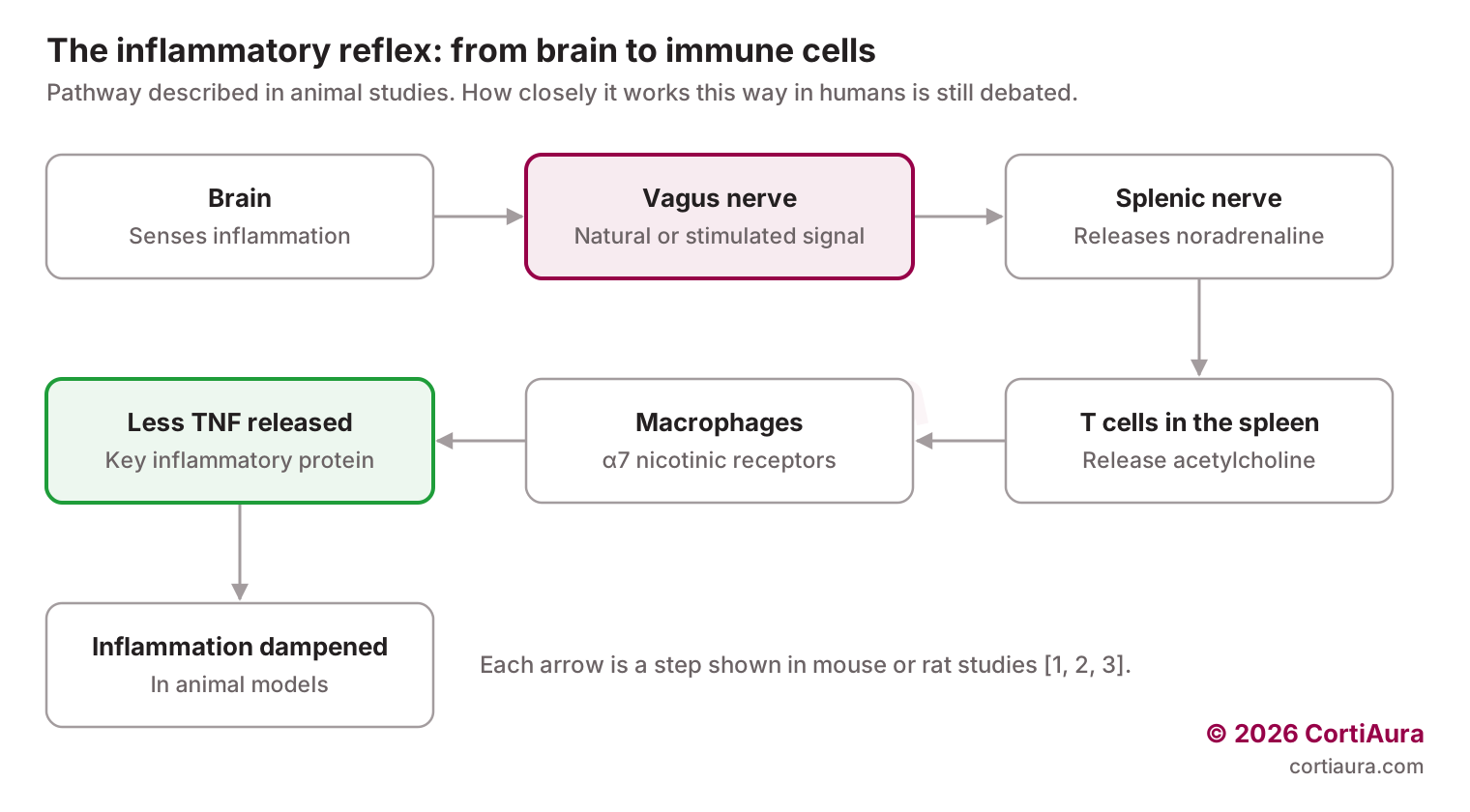
In mice and rats, the outgoing signal follows a relay [1, 3]:
- The vagus nerve signals to the splenic nerve, which supplies the spleen, a major reservoir of immune cells.
- The splenic nerve releases noradrenaline onto a special group of T cells.
- Those T cells release acetylcholine, the same messenger the vagus nerve itself uses.
- Acetylcholine binds to receptors on macrophages, the immune cells that produce TNF, and they release less of it.
The finding that T cells act as a relay was itself a surprise. Without them, vagus nerve stimulation no longer reduced inflammation in mice [3].
What the human evidence shows
Animal results do not always carry over to people. In this field, though, some have, at least in part.
Rheumatoid arthritis. In a 2016 study of 17 people with rheumatoid arthritis, an implanted vagus nerve stimulator reduced TNF production and improved disease activity, including in some who had not responded to several drugs [4]. A larger randomised trial followed: 242 adults whose arthritis had not responded to at least one advanced drug received an implanted device, switched on or left off (sham). After three months, 35.2% of the stimulated group improved by a standard measure, compared with 24.2% on sham [5]. In 2025, the US Food and Drug Administration approved this device [6]. The trial's lead investigator described it as the first device approved for any autoimmune disease [10].
Crohn's disease. Small pilot studies in Crohn's disease have used implanted stimulators. In one, five of nine patients reached deep remission. In another, three of eight patients whose disease had resisted biologic drugs reached clinical remission [7]. These are encouraging, but they are tiny studies without a control group.
Non-invasive stimulation. Devices that stimulate the vagus nerve through the skin of the ear or neck are being studied for inflammation too. The results so far are mixed, as the next section explains.
What we still don't know
The inflammatory reflex is real science, but popular posts often overstate it. Three points are worth knowing.
The wiring is still debated. The neat brain-to-spleen pathway comes mainly from rodent studies. One study in rats found no direct nerve connection between the vagus and the nerve cells that supply the spleen, suggesting the link works in a less direct way than diagrams imply [8]. A gastroenterology review notes that in the gut, the vagus nerve does not reach immune cells directly either, and acts through local nerve cells instead [7].
Human results are inconsistent. A 2024 systematic review pooled studies of 1,021 people who received vagus nerve stimulation or a sham. Most inflammatory markers were slightly lower after stimulation, but none of the reductions in TNF or IL-6 were statistically significant. The authors concluded that the evidence "does not substantiate the claim" that stimulation reliably lowers inflammatory proteins in humans, and called for better studies [9].
Approval is narrow. The approved device is surgically implanted and approved in the US for one condition, rheumatoid arthritis, in people who have not responded to other treatments [5, 6]. It does not show that ear clips, apps or breathing techniques treat inflammation.
The vagus nerve can influence inflammation. Whether stimulating it helps a particular person, with a particular condition, still has to be proven condition by condition.
So the honest summary is this: the vagus nerve is part of how the body regulates inflammation, and stimulating it has helped in some carefully studied conditions. It is not a general "healing nerve" that can be switched on to fix chronic inflammation.
Why it matters for the gut
The gut holds a large share of the body's immune cells, and it is wired to the brain through the vagus nerve. That makes the inflammatory reflex especially interesting in gastroenterology.
In inflammatory bowel disease, such as Crohn's disease and ulcerative colitis, researchers have found that vagal tone tends to be lower, and that this is linked to higher TNF levels [7]. TNF is the same protein that several of the most effective Crohn's drugs block. That overlap is why gastroenterologists are watching vagus nerve research closely.
It also helps explain why stress and gut symptoms so often travel together. Stress shifts the nervous system away from vagal "rest and digest" activity, which shows up as lower heart rate variability.
For now, the practical message is simple. If you have an inflammatory condition, keep to the treatment plan agreed with your doctor. Habits that support vagal tone, such as regular exercise, good sleep and slow breathing, are worthwhile for general health. They are not a replacement for medical treatment.
To learn more, read what the vagus nerve does and why we need to measure the gut-brain axis.
Frequently asked questions
What is the inflammatory reflex? It is a nerve circuit, first described in animals, in which the brain senses inflammation and sends signals through the vagus nerve that reduce the release of inflammatory proteins such as TNF [1, 2].
Can vagus nerve stimulation reduce inflammation? In animal studies, yes. In humans, an implanted stimulator improved rheumatoid arthritis in a randomised trial and is approved in the US for that use [5, 6]. Across all human studies, though, effects on inflammatory blood markers have been inconsistent [9].
Do ear or neck vagus nerve devices treat inflammation? That has not been proven. Research is ongoing, and results so far are mixed [9]. Speak to your doctor before using any device for a medical condition.
Can I improve my vagal tone naturally? Regular exercise, good sleep and slow breathing are linked to higher heart rate variability, a marker of vagal activity. They support general health but are not a treatment for inflammatory disease.
Declaration of interest: The author is the founder of CortiAura, a company developing vagus nerve technology. This article is educational and makes no claims about any CortiAura product.
References
- Borovikova LV, Ivanova S, Zhang M, et al. Vagus nerve stimulation attenuates the systemic inflammatory response to endotoxin. Nature 2000;405(6785):458–462.
- Tracey KJ. The inflammatory reflex. Nature 2002;420(6917):853–859.
- Rosas-Ballina M, Olofsson PS, Ochani M, et al. Acetylcholine-synthesizing T cells relay neural signals in a vagus nerve circuit. Science 2011;334(6052):98–101.
- Koopman FA, Chavan SS, Miljko S, et al. Vagus nerve stimulation inhibits cytokine production and attenuates disease severity in rheumatoid arthritis. Proceedings of the National Academy of Sciences USA 2016;113(29):8284–8289.
- Tesser JRP, Crowley AR, Box EJ, et al. Vagus nerve-mediated neuroimmune modulation for rheumatoid arthritis: a pivotal randomized controlled trial. Nature Medicine 2026;32(1):369–378.
- Healio Rheumatology. FDA approves vagus nerve stimulator for rheumatoid arthritis. 2025.
- Bonaz B. Is there a place for vagus nerve stimulation in inflammatory bowel diseases? Bioelectronic Medicine 2018;4:4.
- Bratton BO, Martelli D, McKinley MJ, et al. Neural regulation of inflammation: no neural connection from the vagus to splenic sympathetic neurons. Experimental Physiology 2012;97(11):1180–1185.
- Schiweck C, Sausmekat S, Zhao T, et al. No consistent evidence for the anti-inflammatory effect of vagus nerve stimulation in humans: a systematic review and meta-analysis. Brain, Behavior, and Immunity 2024;116:237–258.
- Arizona Arthritis & Rheumatology Associates. Pivotal AARA clinical research on non-medicine RA treatment published in Nature Medicine. 2026.
© 2026 CortiAura. Text and illustrations may not be reproduced without permission.
This article is for general information only and is not medical advice. If you have symptoms that concern you, speak to your GP.