
Scroll through social media and you will be told to hum, gargle, splash your face with ice water or breathe like a bee to "tone" your vagus nerve. Vagal tone has become a wellness buzzword.
It is also a real physiological idea, but a narrower one than most posts suggest. As a gastroenterologist, I see the vagus nerve's work every day in the gut. Here is what vagal tone actually means, how it is measured, and which ancient and modern practices have evidence behind them.
What vagal tone actually means
The vagus nerve is the main nerve of the parasympathetic, or "rest and digest", nervous system. It runs from the brainstem to the heart, lungs and gut.
Even at rest, the vagus nerve sends a steady stream of signals to the heart that hold it below its natural pace. Without them, a resting heart would beat at around 100 beats a minute. Vagal tone is the size of that steady background influence [1].
Three points are often lost online:
- It is not one number. No blood test or scan reads out "your vagal tone". Researchers estimate it indirectly, mostly from heart rhythm [1, 2].
- It mainly describes the heart. Most vagal tone research measures the vagus nerve's effect on the heart, not on the gut or other organs.
- Higher is not always better. Very high vagal activity can cause fainting or a very slow pulse. What matters is a nervous system that responds flexibly: calming down at rest and stepping up when you need it.
You may also see vagal tone linked to polyvagal theory, a popular framework in some therapy and wellness circles. Its core physiological premises are disputed. A 2023 review in Biological Psychology argued that each of its five basic premises is untenable or highly implausible [11].
How vagal tone is measured
The most reliable way to measure the vagus nerve's hold on the heart is a laboratory test: a drug called atropine briefly blocks the nerve's signals, and the rise in heart rate shows how much braking the nerve was doing [1]. That is not something anyone does at home.
Instead, researchers use heart rate variability (HRV), the natural beat-to-beat variation in your heart rhythm. Two measures are most closely tied to the vagus nerve [2]:
- RMSSD, the measure most wearables report. It tracks quick, beat-to-beat changes.
- Respiratory sinus arrhythmia, the speeding up of the heart as you breathe in and slowing as you breathe out.
HRV is a useful window, but it is not a perfect one. Breathing rate and depth, age and body weight all change HRV readings, separately from the vagus nerve itself [1]. That matters when you read claims about quick fixes, as we will see.
For more on reading HRV, see our guide to heart rate variability.
Why vagal tone matters
Lower vagal activity, measured as lower HRV, is linked with poorer health in large studies.
- Heart. In people without known heart disease, low HRV was linked with a 32–45% higher risk of a first cardiovascular event [4].
- Ageing. HRV falls steadily as we get older [3].
- The gut. The vagus nerve carries signals both ways between the gut and the brain, and it helps regulate inflammation. We explain this in the inflammatory reflex and why we need to measure the gut–brain axis.
These are associations. Low vagal tone can be a sign that the body is under strain, but that does not prove that raising an HRV number will, by itself, prevent disease.
What lowers vagal tone
The factors that pull vagal activity down are mostly familiar ones:
- Age, which you cannot change [3].
- Alcohol. In more than 4,000 Finnish employees, alcohol lowered HRV during the first hours of sleep, even after small amounts [6].
- Inactivity, poor sleep, prolonged stress and acute illness such as an infection.
- Some medicines, including several antidepressants [12]. Never stop or change a medicine because of an HRV reading; speak to your doctor first.
What reliably raises it
The best-supported ways to raise resting vagal activity are not hacks. They are habits.
Regular exercise has the strongest evidence. A 2024 network meta-analysis of randomised trials found that interval training, strength training and combined programmes all improved HRV in adults [5]. The benefit builds over weeks, not minutes.
Slow breathing works in the moment. Breathing at fewer than 10 breaths a minute consistently increased HRV in a review of 15 studies of healthy adults, although the authors called the evidence limited [7].
There is a catch. Slow, deep breathing makes the heart rhythm swing more with each breath, so it raises HRV readings partly through the breathing pattern itself [1]. A bigger number during the exercise does not necessarily mean your resting vagal tone has changed. It is still a useful, free way to settle the body.
Sleep and less alcohol. Both remove things that suppress vagal activity [6]. They are unglamorous, but they are among the most dependable changes you can make.
Ancient and modern practices: what the evidence says
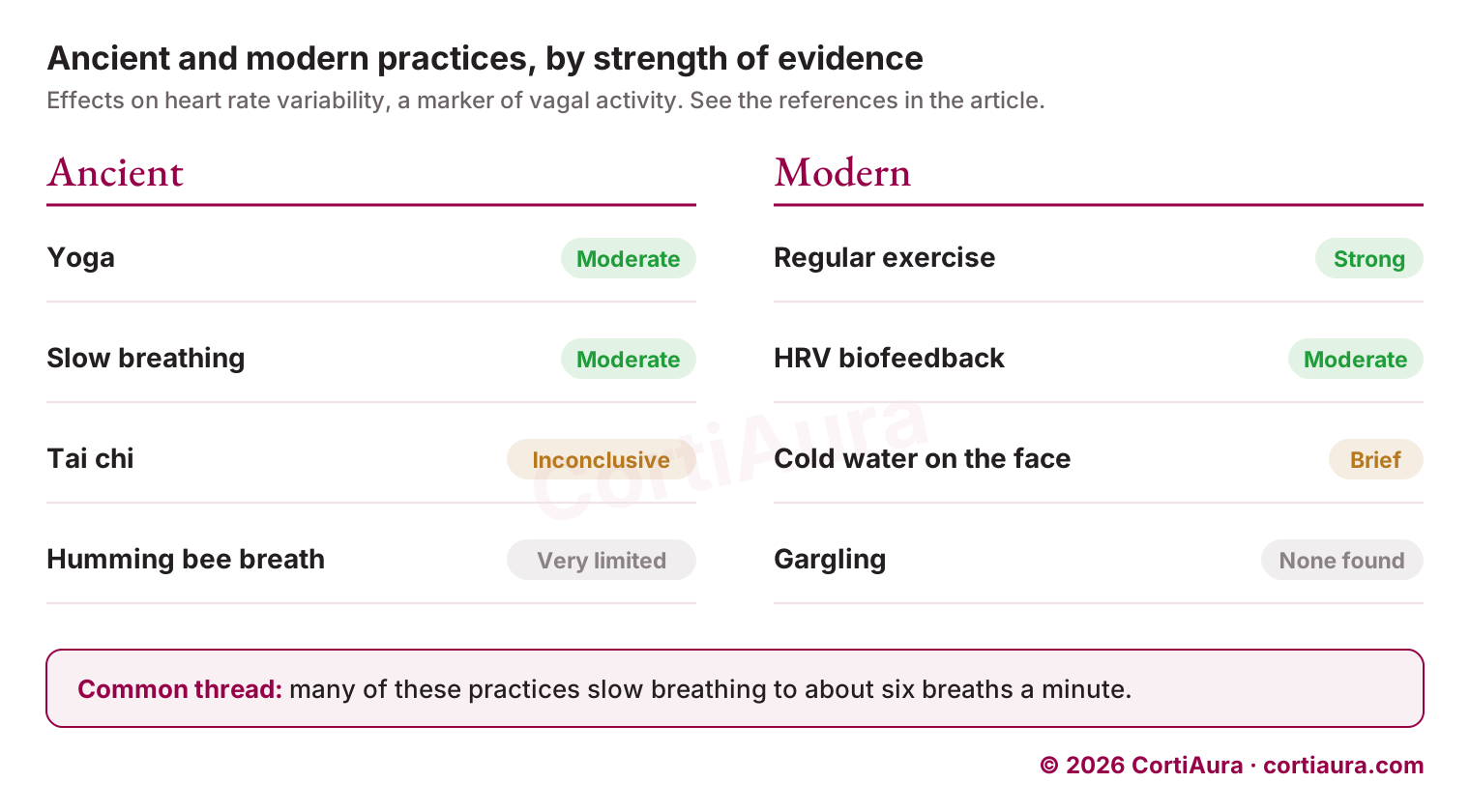
Long before anyone could measure heart rhythm, many traditions developed practices that calm the body. Modern research is now testing them alongside newer techniques. The strength of the evidence varies a great deal.
Ancient practices
Pranayama. Yogic breath control is one of the oldest recorded forms of slow breathing. Modern studies of slow breathing, at fewer than 10 breaths a minute, consistently show higher HRV during practice [7].
Bhramari, the humming bee breath. This pranayama adds a humming sound to a slow out-breath. A systematic review found six small studies, none randomised and all of very low quality. In one, heart rate fell by 2–3 beats a minute [13].
Yoga and tai chi. A meta-analysis of 17 randomised trials found small improvements in HRV measures of nervous system balance and a large reduction in perceived stress. The evidence was stronger for yoga; for tai chi it was inconclusive [14].
Modern practices
HRV biofeedback. A live display of your heart rhythm guides you to breathe at your own "resonance" pace, usually close to six breaths a minute. Across 24 studies it produced large reductions in self-reported stress and anxiety [8].
Cold on the face or neck. This triggers the diving reflex. In 61 healthy adults, 16 seconds of cold on the side of the neck raised HRV and slightly slowed the heart; the cheek had a smaller effect [9]. The effect is real but brief. Splashing cold water on your face is generally safe, but sudden full-body immersion in cold water can be dangerous. If you have a heart condition, ask your doctor first.
Humming and singing. In a small choir study, singing and humming changed heart rhythm mainly by slowing and regulating breathing [10].
Gargling. A popular social media tip. We found no published study measuring its effect on vagal activity.
Wearables. Watches, rings and chest straps measure HRV; they do not raise it. Used consistently, they can show how your habits affect your trend over weeks.
A common thread
Many of these practices, ancient and modern, slow breathing to around six breaths a minute. That pace makes the heart rhythm swing most with each breath, which raises HRV readings [1].
Traditional practices slowed the breath centuries before heart monitors could show why it helps.
The bottom line
Vagal tone is real physiology: the vagus nerve's steady calming influence, mostly measured through the heart. It is linked with health, but it is not a single number, and higher is not automatically better.
The habits with the best evidence are regular exercise, enough sleep and less alcohol. Slow breathing is a free and useful way to settle your body in the moment. Ancient practices such as yoga, tai chi and pranayama share one powerful ingredient with modern biofeedback: slow, steady breathing. Most viral tips either work the same way or have not been tested.
If you have symptoms such as dizziness on standing, a very slow or racing pulse, fainting, or persistent gut symptoms, speak to your GP rather than trying to fix them yourself.
To learn more, read what the vagus nerve does and heart rate variability explained.
Frequently asked questions
What is vagal tone? It is the steady background influence of the vagus nerve, mainly on the heart, that keeps your resting heart rate below its natural pace. It is usually estimated from heart rate variability [1, 2].
How can I check my vagal tone? There is no direct home test. Resting HRV from a chest strap or wearable, measured at the same time each day, gives a rough guide. Watch the trend over weeks rather than any single reading.
What is the fastest way to stimulate the vagus nerve? Slow breathing, at fewer than 10 breaths a minute, increases HRV within minutes [7]. Cold water on the face triggers the diving reflex, which briefly slows the heart [9]. Neither has been shown to change resting vagal tone on its own.
Do yoga or tai chi improve vagal tone? Randomised trials show small improvements in HRV with yoga; for tai chi the evidence is inconclusive [14]. Both include slow, steady breathing, which raises HRV during practice [7].
Declaration of interest: The author is the founder of CortiAura, a company developing vagus nerve technology. This article is educational and makes no claims about any CortiAura product.
References
- Berntson GG, Cacioppo JT, Grossman P. Whither vagal tone. Biological Psychology 2007;74(2):295–300.
- Laborde S, Mosley E, Thayer JF. Heart rate variability and cardiac vagal tone in psychophysiological research. Frontiers in Psychology 2017;8:213.
- Shaffer F, Ginsberg JP. An overview of heart rate variability metrics and norms. Frontiers in Public Health 2017;5:258.
- Hillebrand S, Gast KB, de Mutsert R, et al. Heart rate variability and first cardiovascular event in populations without known cardiovascular disease: meta-analysis and dose-response meta-regression. Europace 2013;15(5):742–749.
- Yang F, Ma Y, Liang S, Shi Y, Wang C. Effect of exercise modality on heart rate variability in adults: a systematic review and network meta-analysis. Reviews in Cardiovascular Medicine 2024;25(1):9.
- Pietilä J, Helander E, Korhonen I, et al. Acute effect of alcohol intake on cardiovascular autonomic regulation during the first hours of sleep in a large real-world sample of Finnish employees. JMIR Mental Health 2018;5(1):e23.
- Zaccaro A, Piarulli A, Laurino M, et al. How breath-control can change your life: a systematic review on psycho-physiological correlates of slow breathing. Frontiers in Human Neuroscience 2018;12:353.
- Goessl VC, Curtiss JE, Hofmann SG. The effect of heart rate variability biofeedback training on stress and anxiety: a meta-analysis. Psychological Medicine 2017;47(15):2578–2586.
- Jungmann M, Vencatachellum S, Van Ryckeghem D, Vögele C. Effects of cold stimulation on cardiac-vagal activation in healthy participants: randomized controlled trial. JMIR Formative Research 2018;2(2):e10257.
- Vickhoff B, Malmgren H, Åström R, et al. Music structure determines heart rate variability of singers. Frontiers in Psychology 2013;4:334.
- Grossman P. Fundamental challenges and likely refutations of the five basic premises of the polyvagal theory. Biological Psychology 2023;180:108589.
- Licht CMM, de Geus EJC, Zitman FG, et al. Association between major depressive disorder and heart rate variability in the Netherlands Study of Depression and Anxiety (NESDA). Archives of General Psychiatry 2008;65(12):1358–1367.
- Kuppusamy M, Kamaldeen D, Pitani R, Amaldas J, Shanmugam P. Effects of Bhramari Pranayama on health: a systematic review. Journal of Traditional and Complementary Medicine 2018;8(1):11–16.
- Zou L, Sasaki JE, Wei GX, et al. Effects of mind–body exercises (Tai Chi/Yoga) on heart rate variability parameters and perceived stress: a systematic review with meta-analysis of randomized controlled trials. Journal of Clinical Medicine 2018;7(11):404.
© 2026 CortiAura. Text and illustrations may not be reproduced without permission.
This article is for general information only and is not medical advice. If you have symptoms that concern you, speak to your GP.